Introduction: What is Benefits of Using a Paddy Thresher Over Manual Threshing?
Agriculture has evolved significantly over the years, especially in harvesting and post-harvest operations. One of the most important stages after cutting paddy is threshing — the process of separating grains from the harvested crop. Traditionally, this work was done manually, which required heavy labor, time, and physical effort. Today, farmers are shifting toward mechanization to improve efficiency. That is why understanding Benefits of Using a Paddy Thresher Over Manual Threshing is essential for modern farmers.
If we clearly define Benefits of Using a Paddy Thresher Over Manual Threshing, it refers to the advantages farmers gain when they use a mechanical paddy thresher instead of traditional manual threshing methods like beating crops against hard surfaces or using animals for trampling.
In this blog, we will explain in detail Benefits of Using a Paddy Thresher Over Manual Threshing, how a paddy thresher works, and why this product is becoming a necessary tool in modern farming.
What is a Paddy Thresher?
Before discussing the Benefits of Using a Paddy Thresher Over Manual Threshing, it is important to understand what a paddy thresher is.
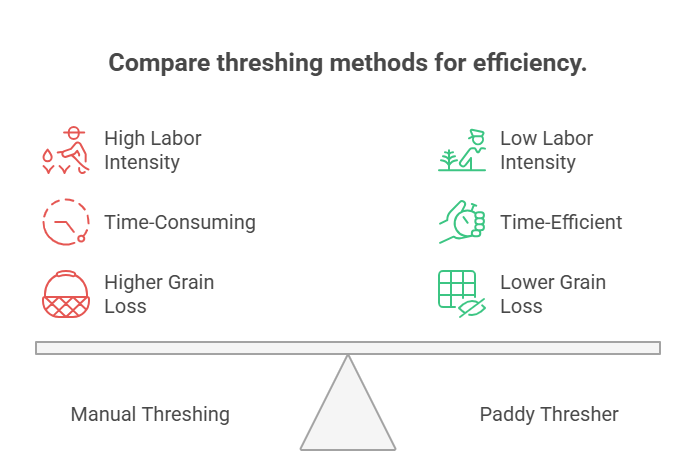
A paddy thresher is an agricultural machine designed to separate rice grains from harvested paddy stalks. It can be operated manually, electrically, or through a tractor power take-off (PTO). The machine performs threshing quickly and efficiently, reducing the need for heavy manual labor.
Understanding this basic concept helps us clearly see the Benefits of Using a Paddy Thresher Over Manual Threshing.
How Manual Threshing Works
To better understand the Benefits of Using a Paddy Thresher Over Manual Threshing, let’s briefly look at traditional methods.
In manual threshing:
- Paddy bundles are beaten against wooden planks or drums.
- Animals are sometimes used to trample the harvested crop.
- Workers manually separate grains using sticks.
- Cleaning is done separately by winnowing.
This process is time-consuming, labor-intensive, and often results in grain loss. That is why farmers are now focusing more on the Benefits of Using a Paddy Thresher Over Manual Threshing.
health issues. A paddy thresher minimizes manual handling, making farming safer and more comfortable.
Key Benefits of Using a Paddy Thresher Over Manual Threshing
Now let’s explore the main Benefits of Using a Paddy Thresher Over Manual Threshing in greater detail. These advantages clearly show why farmers are shifting from traditional methods to mechanized threshing systems.
1. Saves Time
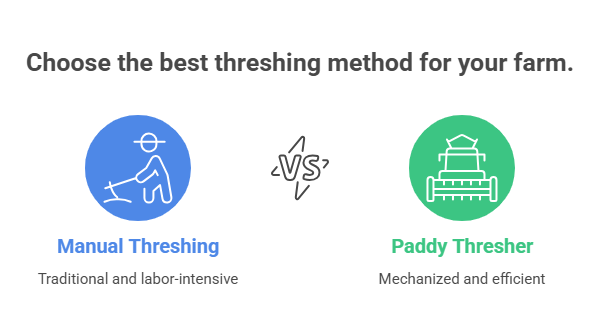
One of the biggest Benefits of Using a Paddy Thresher Over Manual Threshing is time efficiency. During harvest season, time is extremely valuable because crops must be processed quickly to avoid weather damage.
In manual threshing, workers beat the harvested paddy against hard surfaces or use sticks to separate grains. This method is slow and depends entirely on human speed and stamina. It may take several days to thresh crops from just a few acres.
In contrast, a paddy thresher can process large quantities of harvested crop within hours. Some machines can thresh multiple quintals per hour, depending on their capacity. Faster threshing means:
- Quick completion of harvesting operations
- Reduced exposure to rain or moisture
- Faster transportation to storage or market
This dramatic time-saving ability is one of the most important Benefits of Using a Paddy Thresher Over Manual Threshing.
2. Reduces Labor Requirement
Another major point in the Benefits of Using a Paddy Thresher Over Manual Threshing is reduced dependency on labor.
Manual threshing requires a large team of workers. During peak harvesting season, labor demand increases sharply, and wages rise. In many rural areas, labor shortages create serious delays.
With a paddy thresher:
- Only 2–3 people are needed to operate and manage the machine
- Work becomes less dependent on worker availability
- Farmers avoid seasonal labor shortages
This benefit not only saves money but also ensures timely farm operations. Reduced labor requirement is one of the strongest reasons farmers prefer mechanized threshing.
3. Higher Output Capacity
Productivity is another important aspect when discussing the Benefits of Using a Paddy Thresher Over Manual Threshing.
Manual threshing produces limited output per day because workers can only process a small amount of crop at a time. Physical exhaustion further slows the process.
On the other hand, a paddy thresher works continuously with high output capacity. Depending on the model and power source, it can thresh several quintals per hour. This leads to:
- Increased daily production
- Faster completion of post-harvest work
- Ability to manage larger farming areas
Higher productivity directly improves farm efficiency, making this one of the most practical Benefits of Using a Paddy Thresher Over Manual Threshing.
4. Reduced Grain Loss
Grain loss is a serious concern in traditional threshing methods. When crops are beaten manually:
- Some grains fall on the ground and are wasted
- Grains may break due to excessive force
- Separation may remain incomplete
One of the most valuable Benefits of Using a Paddy Thresher Over Manual Threshing is reduced grain loss. The machine is designed with a rotating drum and sieve system that separates grains efficiently without excessive damage.
Advantages include:
- Minimal spillage
- Controlled threshing force
- Better grain recovery percentage
Less grain loss means higher overall yield and improved income for farmers.
5. Better Grain Quality
Grain quality directly affects market price. Manual threshing often results in:
- Broken grains
- Mixed straw and impurities
- Uneven cleaning
Mechanical threshers provide cleaner separation. The grain collected from a paddy thresher is usually:
- More uniform in quality
- Less contaminated with straw
- Better suited for storage
Improved grain quality enhances market value, which strongly supports the Benefits of Using a Paddy Thresher Over Manual Threshing for farmers who aim for higher profits.
6. Cost-Effective in the Long Run
At first glance, purchasing a paddy thresher may seem like a significant investment. However, when analyzing long-term benefits, it becomes clear that this is one of the smartest financial decisions.
Manual threshing involves recurring expenses every season:
- Labor wages
- Food arrangements for workers
- Longer operational time
A paddy thresher reduces these repeated costs. Over several seasons, the savings on labor and time easily compensate for the initial investment.
Therefore, long-term financial savings are one of the strongest Benefits of Using a Paddy Thresher Over Manual Threshing.
7. Faster Field Clearance
After harvesting, quick threshing allows farmers to clear straw and prepare the field for the next crop.
In manual methods, delayed threshing slows down land preparation. This affects the sowing schedule of the next crop.
With mechanized threshing:
- Fields are cleared quickly
- Soil preparation begins earlier
- Multiple cropping cycles become possible
Faster field turnover increases annual productivity, which is another major highlight of the Benefits of Using a Paddy Thresher Over Manual Threshing.
8. Reduced Physical Strain
Manual threshing is physically exhausting. Workers must repeatedly lift, beat, and handle heavy bundles of paddy. This can cause:
- Muscle pain
- Back problems
- Fatigue
- Long-term health issues
One of the often-overlooked Benefits of Using a Paddy Thresher Over Manual Threshing is improved safety and comfort. The machine performs most of the hard work, reducing physical strain on farmers and laborers.
Less manual effort means:
- Safer working conditions
- Reduced injury risk
- Improved overall well-being
9. Improved Operational Efficiency
Another important addition to the Benefits of Using a Paddy Thresher Over Manual Threshing is operational efficiency.
The machine works in a systematic and continuous manner. There is no need to stop frequently, and performance remains consistent throughout the day. This ensures:
- Smooth workflow
- Better planning of farm activities
- Reduced delays
Consistency and reliability are key factors in modern agriculture.
10. Suitable for Large-Scale Farming
As farm sizes increase, manual threshing becomes impractical. A paddy thresher is ideal for medium and large-scale farmers who handle large harvest volumes.
This scalability is one of the strategic Benefits of Using a Paddy Thresher Over Manual Threshing, especially in regions where agricultural production is expanding.
Detailed Comparison: Manual Threshing vs Paddy Thresher
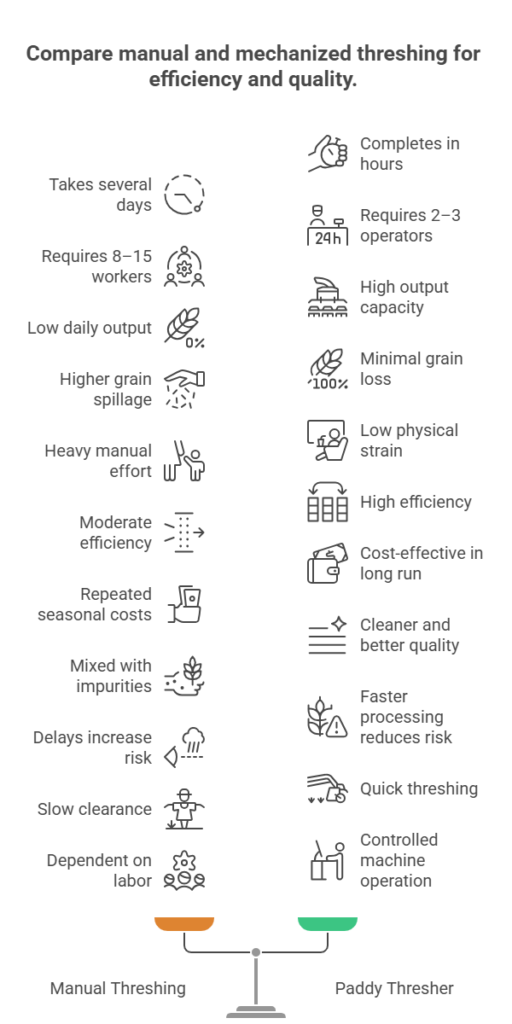
To clearly understand the Benefits of Using a Paddy Thresher Over Manual Threshing, let us expand the comparison in a more detailed table format. This will help farmers easily identify the practical differences between traditional and mechanized threshing methods.
| Factor | Manual Threshing | Paddy Thresher |
| Time Required | Takes several days to complete threshing of a few acres. Work speed depends on labor availability and physical stamina. | Can complete threshing within a few hours. High-speed operation allows quick processing of large quantities. |
| Labor Requirement | Requires 8–15 workers for beating, collecting, and cleaning grains. | Requires only 2–3 operators to manage feeding and monitoring the machine. |
| Output Capacity | Low daily output due to slow manual operations. | High output capacity; can thresh multiple quintals per hour depending on model. |
| Grain Loss | Higher grain spillage and breakage due to uncontrolled beating. | Minimal grain loss with efficient drum and sieve separation system. |
| Physical Effort | Heavy manual effort; causes fatigue and health issues. | Low physical strain; machine performs the hard work. |
| Efficiency | Moderate efficiency; inconsistent grain separation. | High efficiency with uniform and consistent threshing. |
| Cost Over Time | Repeated seasonal labor costs increase overall expenses. | Cost-effective in the long run with reduced recurring labor expenses. |
| Grain Quality | Often mixed with straw and impurities; may contain broken grains. | Cleaner and better-quality grains suitable for storage and market. |
| Weather Risk | Delays increase risk of rain damage and crop spoilage. | Faster processing reduces exposure to unexpected weather conditions. |
| Field Clearance Speed | Slow clearance delays preparation for next crop. | Quick threshing allows faster land preparation and multiple cropping. |
| Operational Control | Dependent on labor coordination and manual effort. | Controlled and systematic machine-based operation. |
Why This Comparison Matters
This expanded comparison clearly highlights the Benefits of Using a Paddy Thresher Over Manual Threshing. While manual methods may appear simple and low-cost initially, they involve higher long-term expenses, more time, and greater physical effort.
Modern farmers prefer mechanized solutions because:
- They increase productivity
- They reduce labor dependency
- They improve grain quality
- They minimize losses
- They support timely crop cycles
By reviewing this table, it becomes evident why the Benefits of Using a Paddy Thresher Over Manual Threshing make mechanization an essential step toward profitable and sustainable agriculture.
Economic Impact on Farmers
Understanding the Benefits of Using a Paddy Thresher Over Manual Threshing also means understanding its economic importance.
1. Increased Profit Margins
Less grain loss and lower labor costs increase net income.
2. Timely Market Supply
Faster threshing ensures crops reach the market at the right time.
3. Stable Production System
Reduced dependency on labor makes farm operations more reliable.
4. Expansion Opportunities
Farmers can expand cultivation area because threshing is no longer a bottleneck.
Environmental and Operational Advantages
The Benefits of Using a Paddy Thresher Over Manual Threshing are not only economic but also practical.
- Cleaner grain separation
- Controlled straw management
- Reduced wastage
- Improved hygiene in grain handling
Modern threshers are designed to reduce dust and improve safety.
Maintenance Tips for Better Performance
To maximize the Benefits of Using a Paddy Thresher Over Manual Threshing, proper maintenance is necessary:
- Regular lubrication of moving parts
- Checking drum and sieves
- Cleaning the machine after use
- Inspecting belts and bearings
- Ensuring proper alignment
Proper care ensures longer machine life and consistent performance.
Role in Modern Agriculture
Agricultural mechanization is the backbone of modern farming. Machines like paddy threshers increase productivity and reduce human effort. The growing demand clearly reflects the strong Benefits of Using a Paddy Thresher Over Manual Threshing.
With rising labor costs and unpredictable weather conditions, farmers need faster post-harvest solutions. Paddy threshers help secure grain quality and reduce operational delays.
Who Should Use a Paddy Thresher?
Farmers who can benefit most from the Benefits of Using a Paddy Thresher Over Manual Threshing include:
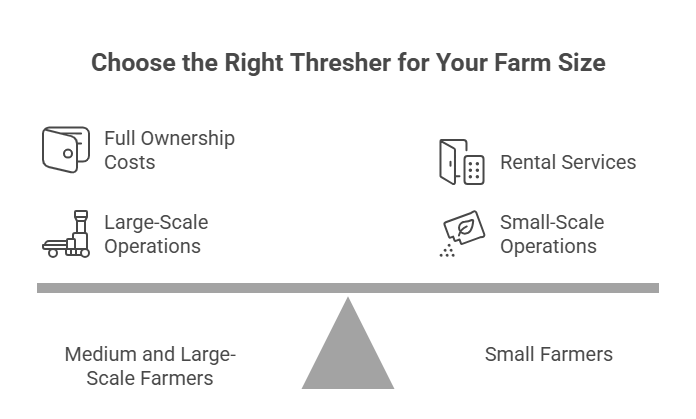
- Medium and large-scale farmers
- Farmer cooperatives
- Custom hiring centers
- Agricultural contractors
Small farmers can also use rental services to enjoy these advantages without full ownership costs.
Conclusion
Threshing is a crucial step in paddy farming. Delays or inefficiencies can reduce grain quality and profits. That is why understanding the Benefits of Using a Paddy Thresher Over Manual Threshing is essential for every farmer.
From saving time and labor to reducing grain loss and increasing profitability, the advantages are clear. Mechanized threshing improves efficiency, supports timely harvesting, and strengthens overall farm productivity.
In today’s modern agricultural environment, investing in a paddy thresher is not just about convenience—it is about ensuring better income, better grain quality, and better farm management. The Benefits of Using a Paddy Thresher Over Manual Threshing make it a smart and practical solution for sustainable farming growth.